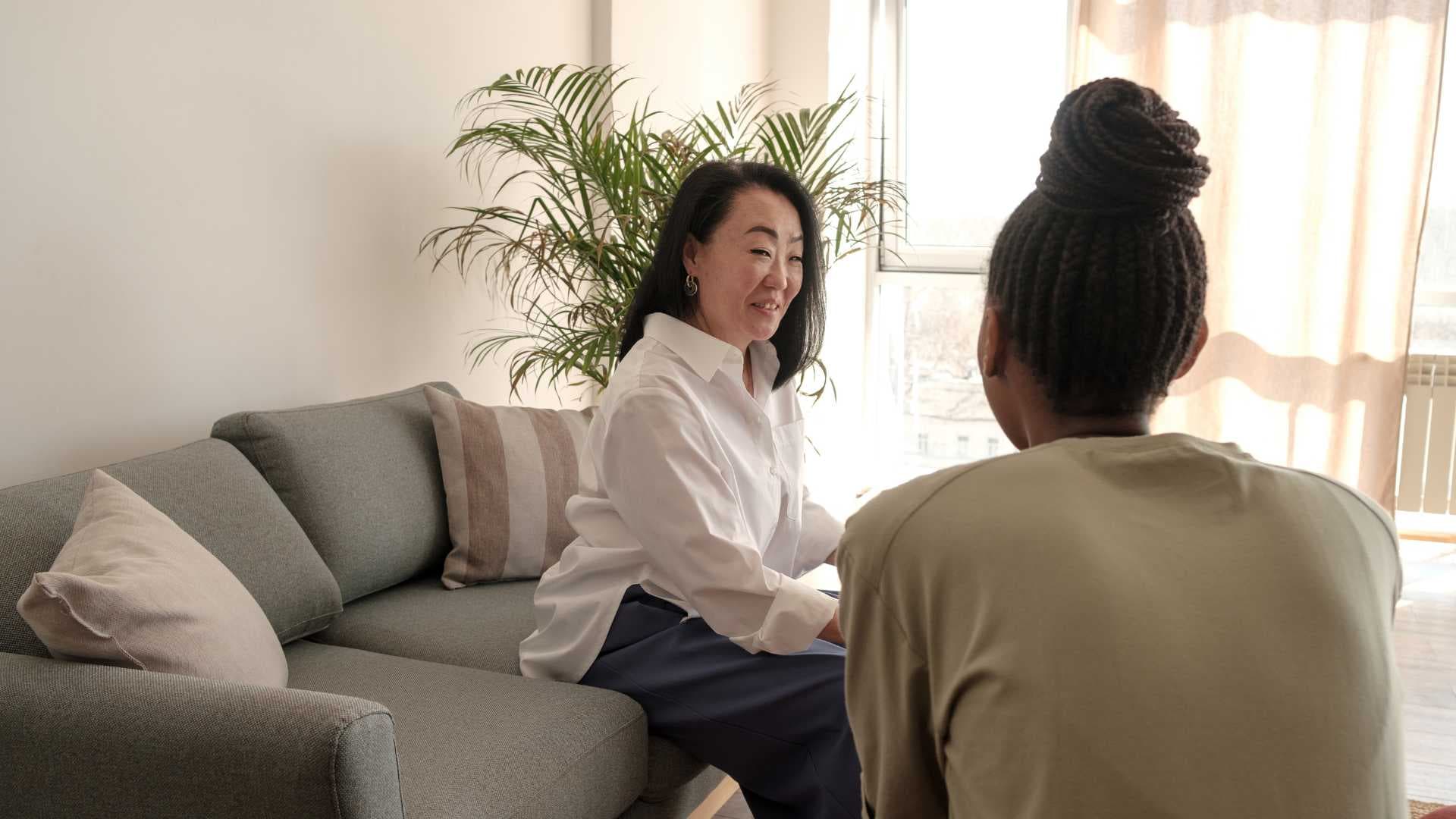
The best therapist bio examples speak to the reader first: who you work with and what it's like to work with you, then your approach, then your qualifications and practical details. Write in the first person for your website and most directories, keep it to 150–300 words, and use plain language rather than clinical jargon.
What should a therapist bio include?
A good bio answers the questions a prospective client is quietly asking, roughly in the order they ask them:
- —Do you work with people like me, and with what I'm struggling with?
- —What would it actually be like to sit in a room (or a video call) with you?
- —How do you work, in words I understand?
- —Are you properly trained and registered?
- —What happens next, and what does it cost?
Most bios we see answer these in reverse: training history first, approach in jargon second, and the reader's experience last, if at all. Flipping the order is the single biggest improvement you can make.
How do you write a therapist bio? A simple structure
| Section | What it does | Length |
|---|---|---|
| 1. Opening | Names who you work with and what they might be feeling, in their language | 1–3 sentences |
| 2. What working with you is like | Describes the feel of sessions: pace, tone, what you'll do together | 2–4 sentences |
| 3. Your approach | Explains your modality in plain English, with the technical name once | 2–3 sentences |
| 4. A little about you | Something human: why you do this work, or what you value. Optional but powerful | 1–2 sentences |
| 5. Credentials | Qualifications, membership and registration, stated accurately | 1–3 sentences or a short list |
| 6. Next step | A gentle invitation and practical details | 1–2 sentences |
Getting credentials right
State memberships and registration exactly as your professional body permits. For example, 'MBACP' means a BACP member, while 'MBACP (Accred)' means accredited; don't imply accreditation you don't hold. Titles such as 'counselling psychologist' and 'clinical psychologist' are protected by law and can only be used if you're registered with the HCPC. If you're in training, say so clearly and name your supervisor arrangements if relevant.
Therapist bio examples for different modalities
The six bios below are fictional and purely illustrative. The names, towns and details are invented. Use them for structure and tone, then write your own in your own voice; a copied bio is easy to spot and won't sound like you.
Example 1: Person-centred counsellor (first person, website)
"If you've been feeling stuck, low or quietly overwhelmed, and you're not sure it's 'bad enough' for counselling, you're very welcome here. I work with adults in Shrewsbury and online who want space to make sense of what's going on, at their own pace.
Our sessions will be led by you. I won't tell you what to do or rush you towards answers. Instead, I'll listen closely, reflect back what I hear, and help you notice what you might already know about yourself. Many people tell me the first session is easier than they expected.
I trained in the person-centred approach, which rests on the belief that, given the right conditions, people can find their own way forward. Before becoming a counsellor I worked in a busy school office for fifteen years, so I know what it's like to look after everyone else first.
I hold a Diploma in Person-Centred Counselling and I'm a registered member of BACP (MBACP). Sessions are 50 minutes and cost £55. If you'd like to talk it through first, you can book a free 15-minute call."
Example 2: CBT therapist (first person, directory)
"Anxiety has a way of shrinking life: avoiding the train, rehearsing conversations, lying awake going over the day. I help adults with anxiety, panic, health worries and OCD understand what keeps those patterns going and practise ways of loosening their grip.
Cognitive behavioural therapy (CBT) is practical and collaborative. We'll agree goals together, look at how your thoughts, feelings and behaviour link up, and try small, manageable experiments between sessions. You'll always have a say in how fast we go.
I'm a BABCP accredited CBT therapist with a Postgraduate Diploma in CBT, and I previously worked in NHS Talking Therapies. I offer daytime and early evening appointments online and in central Leicester."
Example 3: EMDR therapist (first person, website)
"Sometimes the past doesn't stay in the past. A sound, a smell or a tone of voice can bring it rushing back, even when you know you're safe. I work with adults who've been through difficult or traumatic experiences and want to feel less controlled by them.
I use EMDR (eye movement desensitisation and reprocessing), a structured therapy recommended by NICE for post-traumatic stress disorder. We won't start with the hardest memories. The first sessions are about getting to know each other and making sure you have ways to feel steady, and you can pause or stop at any time.
I'm an EMDR Europe accredited practitioner and a registered member of UKCP. I see clients in person in Exeter and online across the UK. If you're unsure whether EMDR is right for you, we can talk it through on a free call first."
Example 4: Couples therapist (first person plural, website)
"Couples often come to us when the same argument keeps happening, when something has broken trust, or when they've drifted into feeling more like housemates than partners. You might both want to be here, or one of you might be less sure. Either is fine.
In our sessions, I won't take sides or decide who's right. My job is to help you both slow down, hear each other differently and understand the patterns you get caught in. Sometimes that leads to a closer relationship; sometimes to a clearer, kinder ending. I'll support you either way.
I'm a psychosexual and relationship therapist accredited by COSRT, with training in emotionally focused approaches. I work with couples of all genders, sexualities and relationship structures, online and in Norwich. Sessions last 75 minutes."
Example 5: Child and adolescent psychotherapist (written to parents)
"If your child is struggling with worry, anger, school or big changes at home, it can be hard to know what's normal and what needs support. I work with children aged 5 to 12 and their parents in Harrogate, and I'll always start by meeting you first, without your child, to hear your concerns.
With younger children, therapy usually happens through play, drawing and stories rather than talking. It gives them a way to show what they can't yet put into words. I'll keep you involved with regular review meetings, while protecting the space your child needs to feel safe.
I'm a child and adolescent psychotherapist registered with UKCP, with an enhanced DBS check and fifteen years' experience in schools and family services. A first parent consultation lasts an hour."
Example 6: Counselling psychologist (third person, group practice)
"Dr Priya Shah is an HCPC-registered counselling psychologist who works with adults experiencing depression, low self-esteem, burnout and the aftermath of difficult relationships. Clients often describe her as warm, thoughtful and quietly direct.
Priya draws on compassion-focused therapy, CBT and schema therapy, adapting her approach to each person rather than fitting them to a model. She's particularly interested in working with people from South Asian backgrounds navigating family expectations and their own identity.
She holds a Doctorate in Counselling Psychology and is a Chartered Member of the British Psychological Society. Priya sees clients on Tuesdays and Thursdays at our Birmingham practice and online."
Notice what these examples have in common: they open with the client's experience, describe what sessions feel like, explain the approach plainly, and state credentials precisely. None promises an outcome. None uses fear.
Should a therapist bio be in first or third person?
| Context | Recommended | Why |
|---|---|---|
| Your own website (solo practice) | First person | Feels direct and personal, as if you're already talking to them |
| Directory profiles | First person | Most profiles are written this way, and it reads more warmly |
| Group practice team page | Third person, or first person consistently | Third person keeps a team page uniform; first person is warmer. Pick one for everyone |
| Speaker, trainer or CPD bios | Third person | Organisers usually expect it and may introduce you with it |
| LinkedIn About section | First person | It's your own profile; third person reads oddly there |
Whichever you choose, use 'you' generously. A bio that says 'you' more than 'I' is usually on the right track.
How do you write a bio for Psychology Today or Counselling Directory?
Directory profiles are often the first thing a prospective client reads, and they're read side by side with a dozen others. A few things help yours stand out:
- —Make the first sentence count. Listings often show only the opening lines before someone clicks, so lead with who you help, not your training.
- —Use the directory's structured fields fully. Issues, modalities, fees, languages, online or in-person: these drive search filters on Psychology Today and Counselling Directory, so complete them accurately.
- —Keep paragraphs short. Most directory traffic is on phones.
- —Use a warm, recent photo, the same one as on your website so people recognise you.
- —Repeat practical details. Location, fees, availability and how to get in touch should be clear without clicking through.
- —Link to your website where the directory allows, and make sure the two say the same thing.
- —Review it every few months. Availability and fees change; outdated profiles cost enquiries.
Directories such as Counselling Directory check qualifications or professional-body membership before listing you, so make sure the details you give match your registration exactly.
Need a starting draft? Our free bio generators turn a few prompts into a first version you can then make your own. Try the free bio generators →
What should you avoid in a therapist bio?
- —Opening with your qualifications. They matter, but they're rarely why someone chooses you.
- —Unexplained jargon: 'integrative, relational, psychodynamically informed' without saying what it means for the client.
- —Long lists of every issue you've ever worked with. Name your main areas; it's more credible.
- —Promises or guarantees: 'I'll help you overcome anxiety for good'. They breach advertising standards and set unfair expectations.
- —Fear-based openings: 'Are you drowning? Is your life falling apart?'
- —Oversharing personal history without thinking through how it affects the therapeutic relationship.
- —Clichés everyone uses: 'safe, non-judgemental space' is fine once, but show it rather than just saying it.
Read your bio aloud as if a nervous client were sitting opposite you. If any sentence would make you wince saying it to their face, rewrite it until it sounds like you on a good day.
Adam Watters, Founder, Psyche Creative
How do you turn your bio into a full About page?
Your website's About page can go further than a directory profile. Use the same structure, then add:
- —A second, more relaxed photo, perhaps in your therapy room.
- —A short section on your values or why you do this work.
- —A plain-English explanation of your professional body and what membership means for the client, such as a complaints procedure and ongoing supervision.
- —Links to the specific service pages that match the issues you mention.
- —The same calm next step that appears on every other page.
A strong photo does a lot of the work in a bio. We've written about getting headshots that feel natural. Read: Therapist headshots →
Your About page sits within the whole website. See how it fits into the patterns that work. Read: Therapist website examples →
If you'd like help with your About page and the rest of your site copy, we write and design therapy websites that sound like the person behind them. See our therapist web design service →
Frequently asked questions
How long should a therapist bio be?
Around 150–300 words for a directory profile and 300–600 words for a website About page. Long enough to feel personal, short enough to read comfortably on a phone.
Should a therapist bio be written in first or third person?
First person works best for your own website and most directories because it feels warmer and more direct. Third person suits group practice team pages, speaker bios and training materials.
What should I put first in my therapy bio?
Start with who you work with and what they might be experiencing, in their own words. Qualifications and training are important but belong later in the bio.
Can I copy a therapist bio example?
Use examples for structure and tone, but write your own. Copied bios rarely sound like you, and prospective clients are choosing a person, not a template.
What should I avoid saying in a counsellor bio?
Avoid promising outcomes, using fear-based questions, unexplained jargon and implying accreditation or titles you don't hold. Protected titles such as 'counselling psychologist' require HCPC registration.
Adam works with UK therapy practices, EMDR trainers and mental health organisations on websites, social media and digital campaigns. He started Psyche Creative to give clinicians a marketing partner who understands the sector — and won't compromise on professional standards to get results.